At Eye Level: An Oxford Walk for People Who Have Already Looked Up

Photo by Photo by Laura on Unsplash on Unsplash
Oxford is a city that trains you to look up. The dome, the towers, the pinnacles, the college gatehouses — they all do their best work above head height. Fair enough. But after you have taken the postcard shot, the city has a second act, and it happens roughly between your knees and the first-floor windows. This walk is about that band: the carved keystones, painted shop signs, bricked-up doorways, dated drainpipes and worn thresholds that sit just below the roofline and just above the pavement.
It is not a secret tour, and it is not a test. You do not need an architectural glossary. You just need to stop treating every building as a backdrop and start reading it like a page.
The rules of the look-lower walk
Pick a band and stick to it. For most of this route, aim your eyes at about 1.5 to 4 metres above the pavement. That is where shopfronts meet first floors, where old signs survive, where stone gets carved and pipes get dated. Look up only when something pulls you there.
Go slowly. This is a 90-minute walk that covers maybe a mile and a half. If you finish it in 40 minutes, you have not done it. Stop on the pavement, step out of the way of buggies and delivery bikes, and give each street a minute of actual looking.
Respect the private bits. College doorways, lodges and garden gates are not exhibits. Admire from the street, keep your voice down, and do not treat a closed door as an invitation.
Start on Broad Street: calibrate your eyes
Broad Street is wide enough to feel like a square and busy enough to make you want to hurry. Do not. Start near the bookshop end and look at the ground floor and first floor of the buildings opposite. Notice how many façades are really two or three buildings pretending to be one. Different brick, different stone, different window heights, a join that does not quite line up.
This is the first lesson: Oxford's centre is a patchwork, not a single design. Once you see the seams, you cannot unsee them. Look for carved keystones above windows — the wedge-shaped stones at the top of an arch, often given a little face or a leaf. Look for old shopfront surrounds, the kind with slim columns and a fascia board that has been repainted so many times the mouldings have gone soft.
Turl Street: the middle distance gets dense
Turn down Turl Street and the scale changes immediately. This is a narrow, shady street where you can read three buildings at once without moving your head. It is also a good place to spot the smaller grammar of the city: brass doorbells, old letterboxes, fanlights above doors, stone thresholds worn into shallow bowls by a century of feet.
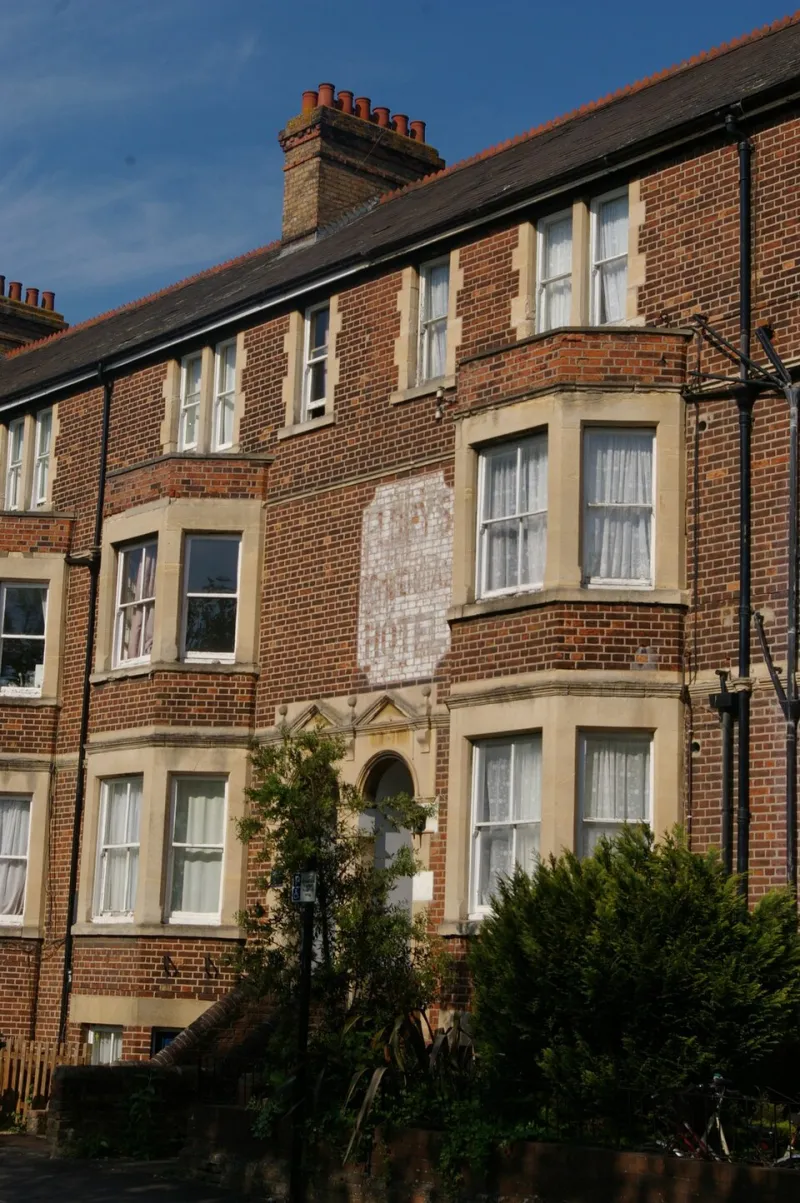
Look for bricked-up openings. Not every blocked doorway is ancient, but the good ones have a story in their edges: a stone arch filled with brick that does not match, a window turned into a wall, a doorway that now goes nowhere. On Turl Street, the colleges and shops sit close together, so you get a nice mix of formal stone and ordinary timber. Keep an eye out for painted signs above ground-floor level — sometimes just a name, sometimes a trade, sometimes a ghostly rectangle where the paint has protected the brick while everything around it faded.
High Street: read the shopfront grammar
Cross to High Street and turn east for a stretch. This is where the look-lower walk becomes a game of compare and contrast. Modern shop signs sit below older ones, and the older ones often survive in the band above the fascia. Look for the outline of letters, the shadow of a former bracket, the ghost of a different trade.
Drainpipes are the underrated stars of this route. Cast-iron hopper heads — the funnel-shaped bits at the top of a downpipe — often carry a date or an initials panel. Once you start noticing them, you will see 19th-century dates scattered along the street like small stamps. Also look at the bases of buildings: ventilation grilles, coal holes, boot scrapers, old iron railings that end abruptly where a wall was rebuilt.
Market Street and the Covered Market: small details, short distances
Cut through Market Street and into the Covered Market. This is the densest section of the walk, and the easiest to do badly. Do not try to see everything. Pick one lane and look at the thresholds, the old tiles, the painted signs above the stalls, the way the roof structure sits on the walls. The market is a working place, so keep moving at the edges and do not block the busiest stalls.
The point is not to catalogue. It is to notice how many layers of use a single doorway can hold: a Victorian shop, a 20th-century sign, a 21st-century fire exit, all stacked in the same frame.
Finish on Cornmarket: the bricked-up city
End on Cornmarket and look at the first-floor band. This is a good place to spot blocked windows and old openings, because the street has been rebuilt and remodelled so often that the façades have become a record of change. Look for arches filled with brick, windows that have been shortened, stone that has been patched with render. None of it is glamorous. All of it is evidence.
What to look for, in short
- Keystones and lintels above windows, especially where the carving is worn but still legible.
- Ghost signs: faded painted lettering above shopfronts.
- Hopper heads and drainpipes with dates or initials.
- Bricked-up doors and windows, and the mismatched brick that gives them away.
- Boot scrapers, coal holes, boundary markers and old door furniture.
- Thresholds worn smooth, and steps that no longer lead anywhere.
Practical notes
This is a flat route and works at any time of day, though early morning and late afternoon are calmer. You do not need a ticket, a guide or binoculars. A phone camera at 2x is plenty. Wear shoes you can stand in, because you will stop more than you expect. Finish with a coffee or a pint and see whether you can remember three details you would have walked past a week ago.
The spires are the headline. The middle distance is the footnote, and the footnotes are where Oxford gets funny, odd and specific. Look lower. The city is still talking.